
You walk into a shop and freeze: which hello is right? Hola works anywhere, but how to say hello in Spanish well also depends on time of day and whether you use tú or usted.
Greetings are the easiest doorway into everyday speech, and the guide on how to learn slang in a new language shows how to build outward from them. The sections below take the most common misunderstandings in turn.
Hola and the other core greetings
The most common way to say hello in Spanish is hola, pronounced OH-lah. According to Lingo Legend’s greetings guide, the letter H is always silent in Spanish, so the word begins with the vowel sound. A common misconception is that a Spanish greeting is a single fixed translation of “hello”. Speakers actually choose among a few set phrases, and the choice signals the time of day and how formal the moment is. Hola sits in the middle as a neutral standard greeting, which makes it the safest default when you cannot judge the setting.
| Greeting | When it fits | Formality | Planning use |
|---|---|---|---|
| Hola | Any setting, any time | Neutral | Default opener when you are unsure |
| Buenos días | Mornings until 12:00 p.m. (noon) | Slightly formal | Polite morning opener, alone or after hola |
| Buenas tardes | Until the sun goes down; depends on the country | Slightly formal | Polite afternoon opener |
| Buenas noches | After the sun goes down or after dinnertime | Slightly formal | Works as a greeting and as a goodbye |
| Buenas | Any time of day | Informal | Short, relaxed hello, like saying “Morning” or “Afternoon” |
| ¿Qué tal? | Casual check-in | Informal | Expect a short reply such as bien or todo bien |
Formality labels and time windows come from Lingvist’s Spanish greetings resource, and the expected reply to ¿qué tal? from Lingo Legend.
Read the table as a ladder. Hola is the rung you can always stand on. The time-based phrases add a touch of politeness, while buenas and ¿qué tal? drop the formality and suit relaxed conversation.
Tú, usted and the formality mistake
Many learners assume the informal choice is always the friendlier one. In Spanish the pronoun carries the politeness, so a wrong guess can sound careless rather than warm.
- Tú is the informal form. Lingo Legend contrasts ¿Cómo estás?, which uses tú, with ¿Cómo está usted?, which uses usted. The verb ending changes with the pronoun (estás versus está), so you can hear which register someone is using.
- Usted suits strangers, elders and professional settings. The same guide advises starting with usted when speaking to strangers, elders, authority figures, or anyone in a professional context.
- Formal address also marks respect. Lingvist describes the formal register as the one for people you are meeting for the first time or who are older than you.
- Vos replaces tú in some regions. Argentina and parts of Central America use vos instead of tú, and it changes the verb conjugations, so a greeting built on tú can sound foreign there.
For a learner, the practical rule follows from this: when you are unsure whether someone counts as a stranger, an elder or a professional contact, usted is the safer choice. Move to tú when the other person does.
Time-of-day greetings and shifting cutoffs
A second misconception is that buenos días ends at noon everywhere. Lingvist gives noon as the general end of the morning window, but Lingo Legend notes that in Spain buenos días often stretches until after lunch, which can be 2 or even 3 PM. In Mexico, by contrast, people start saying buenas tardes right after noon.
This is why the afternoon greeting is described as lasting “until the sun goes down” and “depending on the country”. The labels are guides, not clock rules.
Buenas noches has its own wrinkle. It works as both a greeting and a goodbye, so hearing it as you leave a room does not mean you misjudged the hour. Buenas, the short form, sidesteps the whole question because it fits at any time of day, although it reads as informal.
If you are unsure which window applies where you are, listen to the first greeting you receive and return the same one. That approach respects local habits without memorising any cutoff.
Casual greetings, slang and regional use
Standard greetings tell you what is safe. Casual and regional greetings tell you how people actually sound once the setting relaxes. The Spanish Experiment points out that which casual how-are-you phrase you pick depends on which Spanish-speaking country you come from, so there is no single slang hello to learn.
- ¿Qué tal? (widely understood). It works like “What’s up?” in English, and people do not always expect a response, according to Lingvist. When a reply is wanted, bien or todo bien is usually enough.
- Buenas, buenas (Argentina). Wanderlust Spanish lists the doubled form as very common in Argentina.
- Wena (Chile). The same source describes it as very common in Chile and as a short way to say buenas.
- ¿Qué hubo? (Colombia). It is very common in Colombia and literally means “What happened?”, which shows how a casual greeting can be a question rather than a word for “hello”.
- Pura vida (Costa Rica). Lingo Legend says it is used for everything: hello, goodbye, thank you.
- Diga (Spain, phone). Lingvist lists it as an informal phone greeting common in Spain, glossed as “Tell me”.
These phrases are better recognised than imitated at first. Using a regional greeting back to a local can land well, but it only makes sense once you have heard it used around you. Until then, hola, buenas and ¿qué tal? travel everywhere, and the slang can follow.
Physical greetings: cheek kisses and following the lead
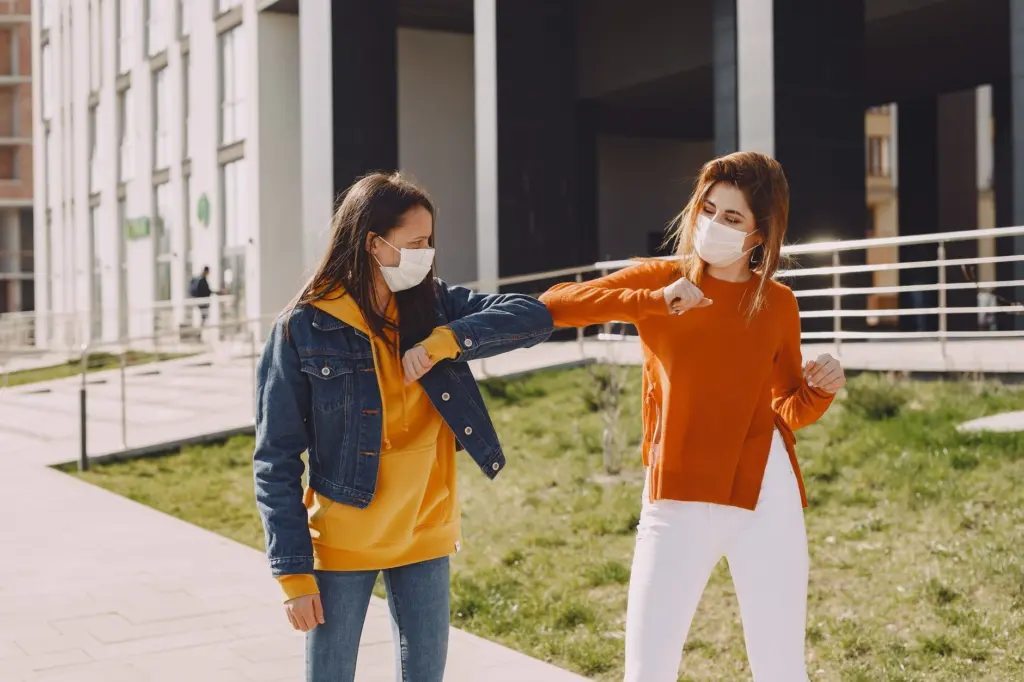
Greetings are not only spoken. In Spain, two cheek kisses are standard, even among people meeting for the first time in social settings, as Lingo Legend describes. Visitors from handshake cultures often expect that gesture to be reserved for close friends, which is why the custom surprises them.
Customs differ between places and people, and Lingvist gives the most useful rule: it is always best to wait for someone else to initiate and follow their lead. A spoken hola or buenas, with a nod or smile, is a complete greeting while you watch what others do.
Practising greetings so they stick
Greetings are best learned in pairs: the opener plus the reply it expects. Practise hola with buenos días as a pair, then ¿qué tal? with bien or todo bien, and say each aloud with the silent H in hola. Flashcards work well if one side shows the situation (morning shop, phone call, old acquaintance) and the other shows the phrase and its formality level.
Neighbouring languages share some of these habits of time-based and formality-based greetings. If you are learning more than one, compare this page with How To Say Hello In Italian: Simple Phrases, When To Use Them, And Cultural Tips (2026) – Slanguagestudio and How To Say Hello In Portuguese: Simple Greetings, Formality & Pronunciation (2026 Guide) – Slanguagestudio.
Frequently asked questions
| Question | Answer |
|---|---|
| How do you say hello in Spanish? | Say hola, pronounced OH-lah with a silent H. It is neutral in formality, so it suits any setting. Add buenos días, buenas tardes or buenas noches to match the time of day. |
| When do I use usted instead of tú? | Use usted with strangers, elders, authority figures and in professional contexts, and with people you are meeting for the first time. Tú is for informal address. |
| How do greetings differ by country? | Time cutoffs, slang and customs all shift. Spain stretches buenos días past noon, Argentina favours buenas, buenas, Chile uses wena, Colombia uses ¿qué hubo?, and Costa Rica uses pura vida. Argentina and parts of Central America also use vos. |
| Does ¿qué tal? need a full answer? | No. It is a casual check-in, and a brief bien or todo bien is the usual reply. |